Principals Lead the Way: Top Ten Things Every Literacy Leader Needs to Know
Principals who lead with a strong commitment to literacy play an important role in fostering a school culture that supports students’ growth as readers. This information is intended to support leaders in extending their work beyond school management to instructional leadership, helping to ensure that teaching practices are grounded in High-Quality Instructional Resources, aligned with the Kentucky Academic Standards for Reading and Writing, and reflect evidence-based structured literacy practices.
Download the Principals Lead the Way Quick Reference Guide to print out for your records.
1. What is the Science of Reading?
Learning to read is a complex process. Scientific research collected over the past four decades reveals what happens in the brain to enable skillful reading. Reading is not hard-wired in the brain. The neuropathways must be developed through explicit, systematic instructional experiences (Lexia, 2022).
The Literacy At a Glance collection defines the six most critical components of literacy (Phonemic Awareness, Phonics, Fluency, Vocabulary, Comprehension, Building Knowledge) and provides instructional recommendations related to each component, including an explanation on how each component aligns with the Kentucky Academic Standards for Reading and Writing.
2. Science of Reading Models
Both the Simple View of Reading (Gough & Tunmer, 1986) and Scarborough's Reading Rope Model (Hollis Scarborough, 2001) convey the multiple components involved in reading.
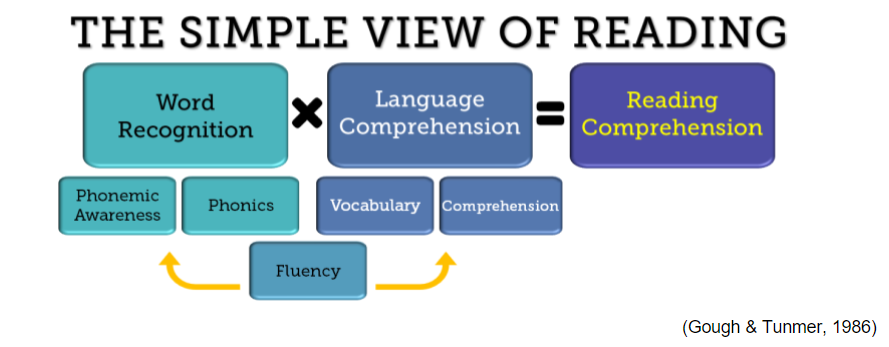 The “Simple View of Reading" model simplifies the complex process of reading into two essential components: Word recognition (phonemic awareness and phonics) and language comprehension (vocabulary and comprehension).
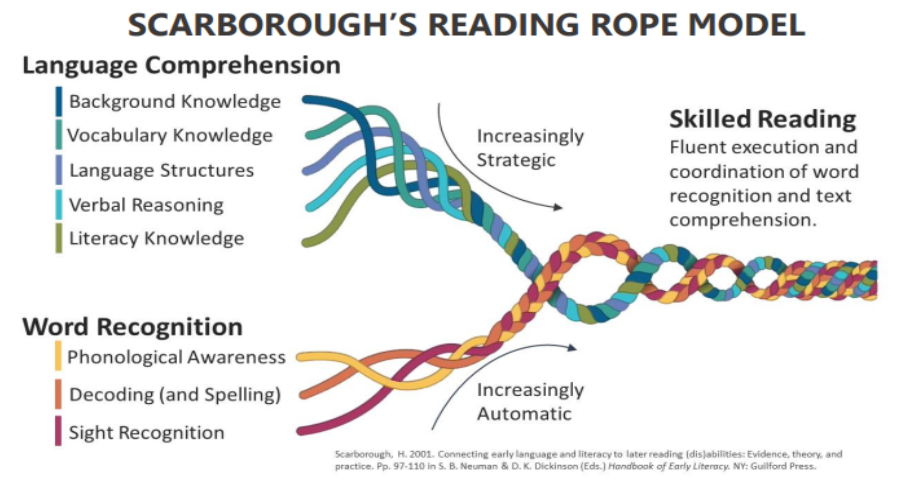 The “Reading Rope" model emphasizes the importance of both word recognition (phonological awareness and phonics) and language comprehension (vocabulary, background knowledge, and verbal reasoning) as essential strands of the “rope" that contribute to reading proficiency.
3. The Need to Shift to Structured Literacy
Structured literacy (SL) is an approach that emphasizes highly explicit (direct instruction with modeling) and systematic (elements taught sequentially) teaching of all essential components of literacy mentioned in #1 & 2. Instruction is cumulative (built on previous knowledge, moving from simple to complex). Each lesson includes meaningful interactions with language in addition to multiple opportunities to practice. Lesson engagement is crucial, and the use of decodable text for students to practice previously learned phonetic patterns is vital.
4. Knowledge-Building Instruction
Knowledge-building instruction begins with high-quality, complex texts rather than choosing texts based on standards. Standards are used in service of comprehension, supporting a deeper understanding of the text's meaning. When students are taught with knowledge-building instruction:
Students engage in a series of lessons or dedicated sessions focused on various aspects of a related topic. This approach facilitates easier learning of new material and vocabulary through familiarity with the subject matter.
The lessons are intentionally structured to build upon each other, allowing students to see new vocabulary applied in different contexts and to develop a deeper understanding of the topic as it is revisited in slightly varied ways.
The instructional activities, including questions, assignments, and reading exercises, are designed to enhance comprehension and promote a comprehensive understanding of the subject.
See Key Action #2 for more details.
5. Tier 1 Core Comprehensive High-Quality Instructional Resource (HQIR)
HQIRs serve as a foundation for increased access to grade-level learning for all students. All KDE-approved HQIR support the learning goals, outcomes and core competencies that students must demonstrate to reach the grade-level expectations within the Kentucky Academic Standards for Reading and Writing. To support effective implementation of an HQIR aligned to structured literacy practices:
Adopt and implement an approved Tier 1 core comprehensive High-Quality Instructional Resource.
Ground literacy instruction in an HQIR, including these 4 Key Actions:
Implement explicit, systematic instruction in foundational skills.
Engage all students in discussion of complex, knowledge-building text and text sets to build comprehension.
Use small-group reading time to target foundational skills or to develop comprehension using complex text.
Provide instructional time to address all five components of reading.
Design master schedules aligned to the instructional requirements of the adopted HQIR.
Depending on the stage of HQIR implementation, review the key actions for school leaders within the Curriculum Implementation Framework to determine the actions that will have the biggest impact on improving the student experience and their ability to engage daily with grade-level content.
6. Professional Learning Communities
Professional Learning Communities (PLCs) create coherence and clarity through structured collaboration that deepens understanding of the HQIR's intentional design, ensuring implementation that systematically builds skills and content across grade levels.
Create and sustain PLC enabling conditions that set clear expectations, model commitment to the work, and ensure the structures and supports are in place for effective collaboration.
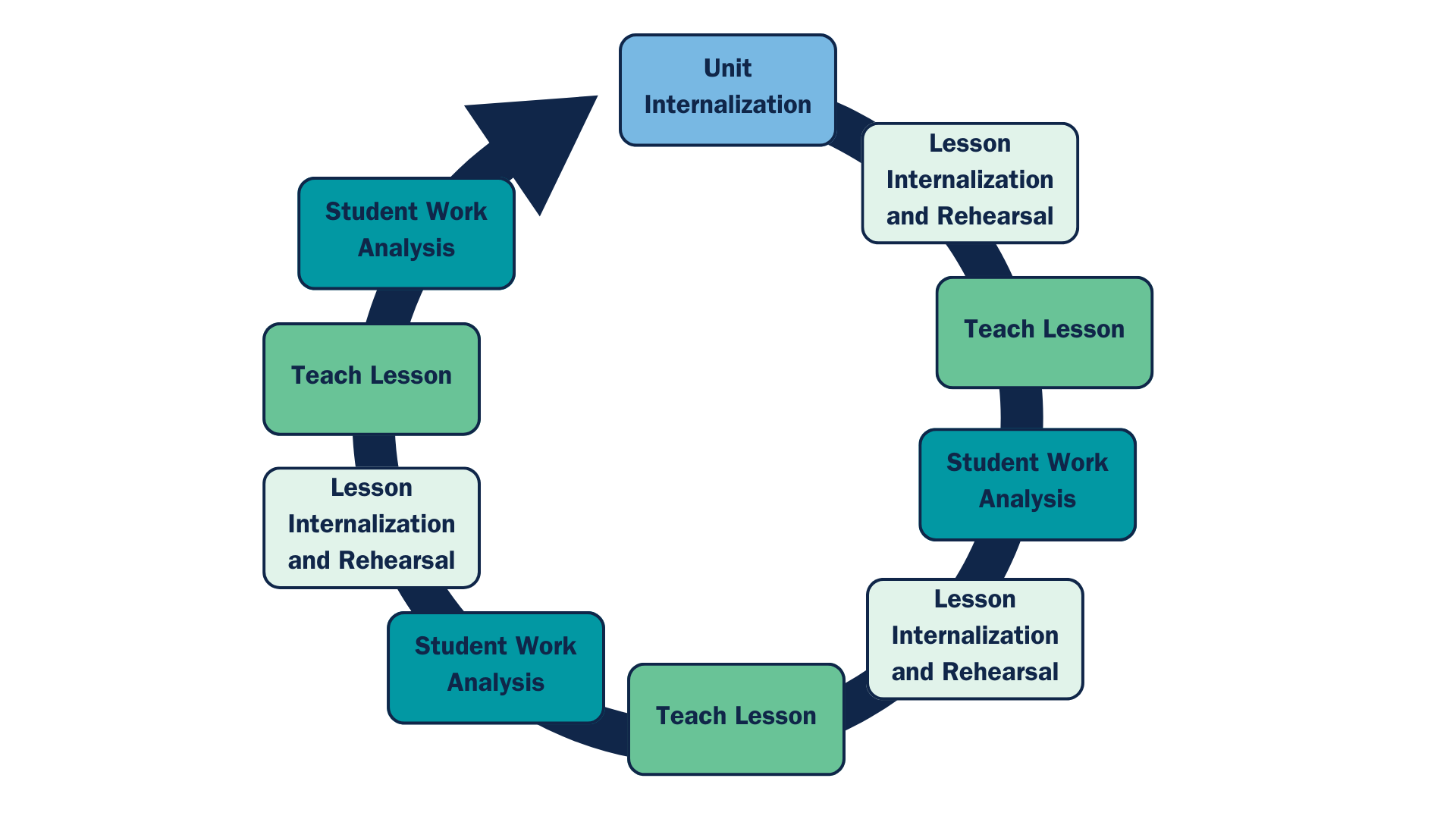
Engage with teachers in collaborative conversations that utilize Intellectual Preparation, starting with Unit/Lesson Internalization Protocols to ensure a deep understanding of instructional goals and content across units.
Align High Quality Professional Learning with school or district instructional vision for Reading/Writing by designing targeted development opportunities that build staff capacity and ensure everyone is working toward the same literacy outcomes.
Use the Curriculum Based Professional Learning PLC Observation Tool to monitor PLC progress.
7. Multi-Tiered System of Supports (MTSS): Tier 1 Instruction
Tier 1 of MTSS provides high-quality, evidence-based instruction for all students that is aligned to grade-level standards, and responsive to diverse learners. Kentucky's MTSS Framework offers research-based practices and tools to support implementation.
Utilize the school MTSS team to complete the KyMTSS Self Assessment Tool to analyze and prioritize areas for instructional improvement.
Ensure ALL students receive high-quality universal Tier 1 instruction through the adopted HQIR. The HQIR has embedded differentiation, and scaffolding supports that core teachers and support specialists (e.g. special education, gifted and talented, English Learners) may use to ensure all students benefit from core instruction.
Align Tier 2 interventions with Tier 1 instruction while using the HQIR.
8. Learning Acceleration and Intervention
Ensuring every student engages in grade-level learning requires a unified approach that prioritizes acceleration and intervention as needed and is grounded in high-quality Tier 1 instruction to advance proficiency. Learning acceleration immerses students in high-quality, standards-aligned grade-level content while intentionally integrating missing prerequisite skills, knowledge and vocabulary through a “just-in-time" approach that keeps students progressing on grade-level trajectories.
Start with strong Tier 1 instruction that engages students in grade-level work through effective teaching, meaningful tasks and high expectations.
Use PLCs for intentional planning—through Intellectual Preparation cycles. By engaging in unit and lesson internalization, teachers are able to identify the skills and content knowledge needed to access upcoming lessons, and through the use of curriculum-embedded assessments, determine whether students possess that learning.
Align systems and supports to reinforce acceleration. The overarching goal of learning acceleration is to focus on quickly identifying and addressing gaps in critical concepts to allow students access to grade-level work rather than being held back by remediation or lower-grade concepts.
Leverage KDE's Early Literacy Resources to strengthen Reading Improvement Plans and guide effective interventions aligned to Tier 1 content.
9. Assessments
Assessment data drives data-based decision-making, guiding targeted instruction and intervention that ultimately help all students achieve literacy success.
Stay informed about school wide assessments. Lead discussion with the instructional team using school-wide data.
Universal Screeners: Given to all students; identifies students who may be at risk of not meeting proficiency in reading.
Diagnostic Assessments: Given to students who are determined to be at-risk as identified by the universal screener; identify specific deficits of at-risk students and guide the next steps for instruction and intervention.
Progress monitoring: Brief, repeated measures that capture students' progress or rate of improvement over time in response to instruction or intervention using valid and reliable measures.
Determine the effectiveness of Tier 1 instruction using curriculum-based assessments; facilitate the Student Work Analysis Protocol in PLCs as part of intellectual preparation, as needed.
10. Effective Feedback
Effective instructional feedback from principals strengthens teaching practices, builds teacher-leader relationships and fosters a culture of continuous improvement. Thoughtful feedback also supports the monitoring of HQIR implementation, ensuring implementation integrity and helping teachers refine instruction to meet student needs.
Get Connected
Stay current with the latest literacy resources aligned with the Science of Reading on KDE's Early Literacy Webpages and in the Early Literacy Newsletter. For more guidance, visit the Connect and Support page.
Please email the Early Literacy team with any questions.